Exhibitions, Research, Criticism, Commentary
A chronology of 3,585 references across art, science, technology, and culture
“It’s like someone wished on a cursed monkey’s paw for an artist who could reflect the truth of this moment, and in Beeple, that wish came true, for better or worse.”
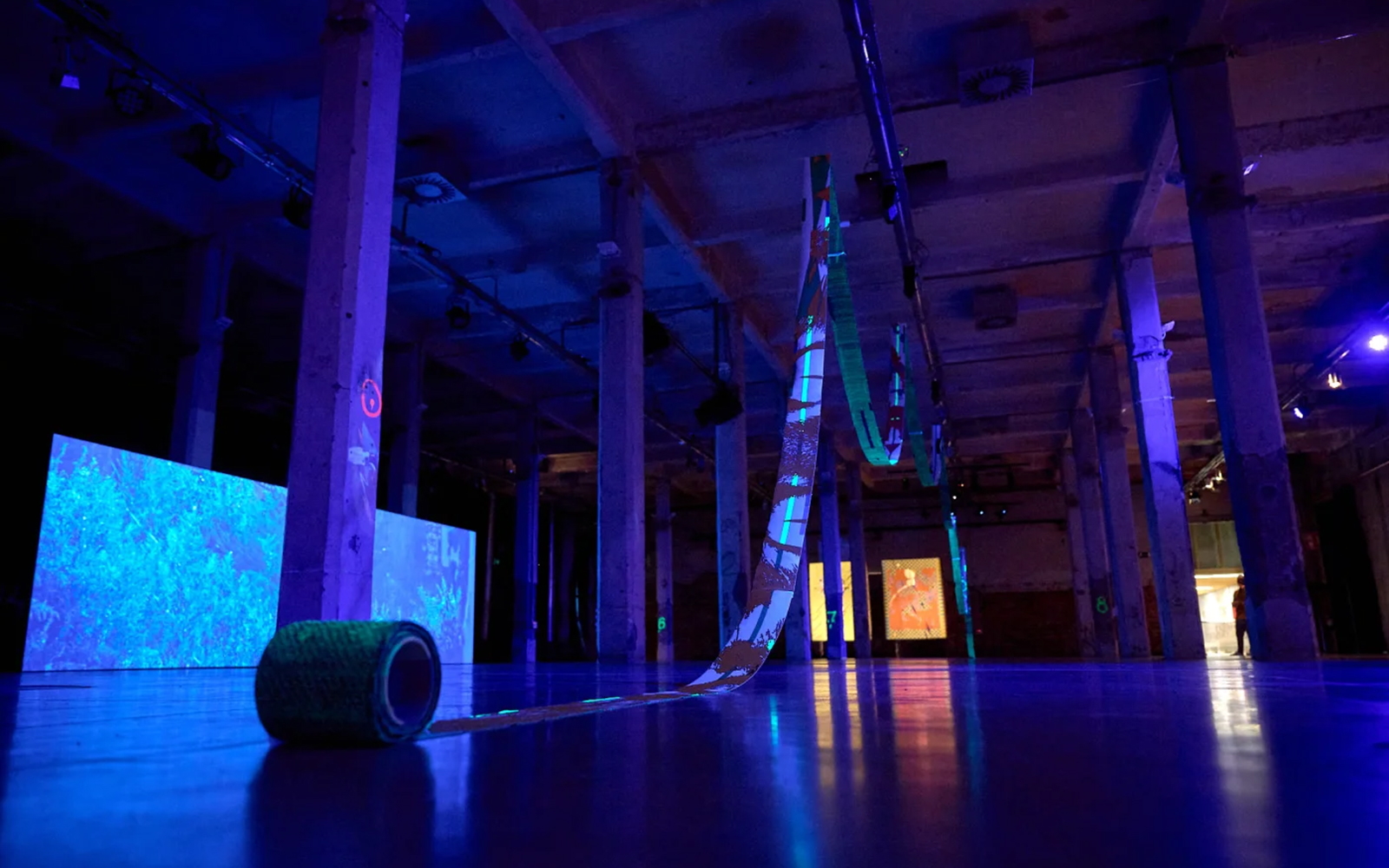
Quantum futures and soft science fiction: Dutch design collective Metahaven presents four video and textile works in “Collapse of the Weave Function” as part of Medialab Matadero’s “Weird Futures” program in Madrid. The titular centrepiece—an ultra-long, ultra-thin woven textile strip traversing the entire exhibition space—is a meditation on Schrödinger’s Cat. Here, however, the cat exists in states of waking and sleeping, countering the alive-or-dead binary with a gentler quantum interpretation.
“They have grandmothers, family bonds and conversations. They mourn their dead. When you listen long enough, you realize their inner worlds might be as complex as ours.”
“It is sad that our society is so generous in considering the sentience of machines, yet so skeptical of other creatures. We sympathize with software that prints ‘I don’t want to die,’ without bothering to learn the languages others use to make the same plea.”
Planetary Peasants
Agriculture, Art, Revolution

Majestic, iridescent, more-than-human: Monira Al Qadiri’s First Sun (2025) reimagines the ancient Egyptian deity Khepri—god of the rising sun—as a contemporary monument at the southeastern entrance of New York’s Central Park. For the Iraqi artist, the gleaming painted aluminum bust of a human-scarab hybrid suggests a future of interspecies kinship, “where even the most humble insects are revered for the essential role they play” in sustaining life on Earth.

“AR brings the garbage back home. You place [the sculpture] on your floor, your desk, and suddenly the line between nature and waste collapses. It’s no longer out there; it’s with you.”
Alyssa Battistoni
Free Gifts: Capitalism and the Politics of Nature

Musician Benn Jordan teaches a rescued European starling named ‘the Mouth’ to reproduce a spectral synthesizer drawing, demonstrating songbirds can function as biological data storage devices. Jordan’s ultrasonic recordings reveal the Mouth replicated the sound-image with striking accuracy, storing 176 KB of information. Going down an avian acoustics rabbit hole, he shows how DIY recording setups can unlock the “hidden and extremely weird world” of bird communication.

Spurred by his participation in the UK exhibitions “More than Human” and “Sea Inside,” CNN’s Francesca Perry dives into Japanese artist Shimabuku’s long-running interspecies collaboration with octopuses—from touring Tokyo with a live cephalopod to gifting octopuses bespoke glass sculptures underwater, probing non-human agency. “They have curiosity,” the artist enthuses about his tentacled muses, and “time for hobbies.”

Agnieszka Kurant’s “COLLECTIVE INTELLIGENCE” at Marian Goodman Gallery NYC surveys a decade of works exploring nonhuman intelligence. The Polish artist presents emergent forms including metal-salt crystal formations Nonorganic Life (2025) and zinc casts of termite mounds from A.A.I. (Systems Negative) series (2016-)—the latter inspired by Jeff Bezos’ “artificial artificial intelligence” concept as monuments to interspecies labour exploitation.

“Whether they’re nesting behind shop signs or pecking at detritus on the street, they seem less like parasites than pioneers who’ve taken up the challenge of rewilding the grossest corners of humanity.”
Daily discoveries at the nexus of art, science, technology, and culture: Get full access by becoming a HOLO Supporter!
- Perspective: research, long-form analysis, and critical commentary
- Encounters: in-depth artist profiles and studio visits of pioneers and key innovators
- Stream: a timeline and news archive with 3,100+ entries and counting
- Edition: HOLO’s annual collector’s edition that captures the calendar year in print