Exhibitions, Research, Criticism, Commentary

A chronology of 3,585 references across art, science, technology, and culture
“In their hands, the mushroom becomes not an object but an inescapable feral imagination, with the exhibition a proposal to clean the plate and start over.”
– Writer and curator Lou Mo, reviewing anthropologist Anna Tsing and architect Feifei Zhou’s interdisciplinary show at Het Nieuwe Instituut (NL). Instead of romanticizing fungi as trendy biomaterial, Mou argues that “Fungi: Anarchist Designers” presents mushrooms as agents whose “boundless growth more closely resembles the expansionism of colonial and capitalist endeavours.”
OUT NOW:
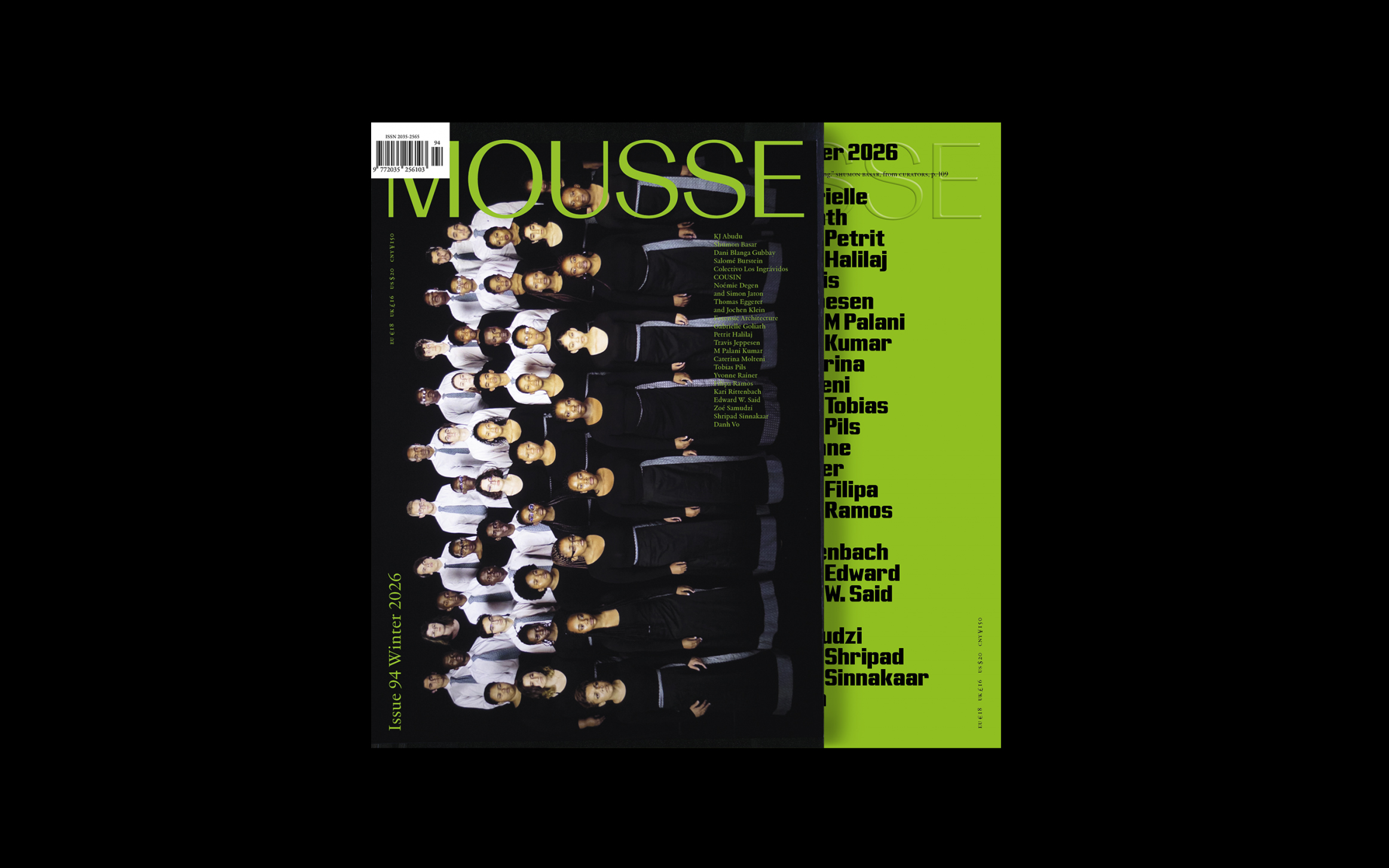
Mousse 94
Mousse’s winter 2026 issue features Forensic Architecture on counter-forensics and their ongoing Gaza Atlas plus Shumon Basar offering an autobiographical reflection on two decades of curatorial work via “The Only Way Out Is Through” at The Third Line, Dubai.
“There was a critic in San Francisco, Thomas Albright, who wrote for The Chronicle and he said my work was the worst ever shown in the Bay Area. It spurred me on. I worked despite all this and sent him copies of reviews until he died.”
– Artist Lynn Hershman Leeson, on the petty satisfaction of outlasting your detractors. Discussing her memoir Private I (2025), the 85-year-old media art pioneer reflects on decades of institutional dismissal—and keeping receipts.
“To curate an exhibition about a world where the principal ideal is decentralization involves a certain contradiction because curation demands selection, exclusion, and gatekeeping.”
– Curator Nina Roehrs, reflecting on the paradox at the heart of her 2022 Kunsthalle Zürich exhibition “DYOR” (Do Your Own Research), one of the first major institutional surveys of blockchain art. Writing in OnCurating’s “Paraverse” issue on post-NFT curation, Roehrs unpacks how Web3’s anti-hierarchical ethos clashes with the very act of exhibition-making.
“Uttered like an incantation, there is no term (other than porn, perhaps) more slippery in its definition yet identifiable in its ubiquity. Slop is everywhere; everything is very sloppy now.”
Ocula Contributing Editor Aimee Walleston, on the rise of AI-generated content. Reaching back to the Zombie Formalism moment in painting, Walleston examines artists from Maya Man to Refik Anadol—distinguishing critical engagement from what she calls “schlock-slop.”

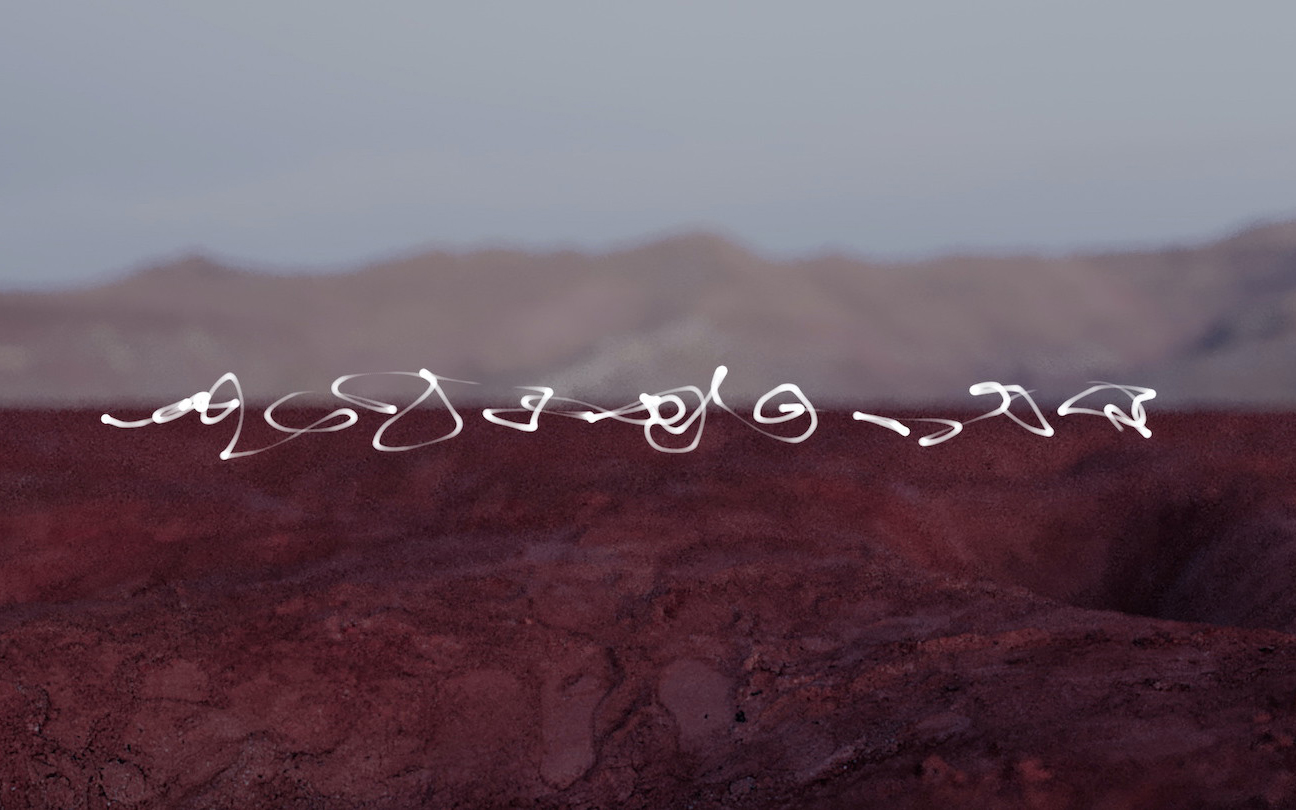
In her final 2025 Artlab Editorial Fellowship essay, writer Elvia Wilk explores Jenna Sutela’s “many-headedness”—channeling of bacteria, slime molds, and machine learning to confound notions of singular authorship. In a close reading of nimiia cétiï (2018), Wilk connects the Finnish artist’s practice to 19th-century spiritualist Hélène Smith, whose ‘Martian language’ structured the video’s uncanny vocalizations. Wilk concludes that Sutela is herself a medium—listening first, then attuning us to new frequencies.
a
“Sculpting sound, Coco Klockner hammers the metallic shells of language into hollow drums. She flattens the syllables, melting them into a resonant bass.”
– Critic Jonah James Romm, on Coco Klockner’s Null Dialogue (2025) at NYC’s SculptureCenter. In the installation, two subwoofers atop sandbeds project a muffled conversation between lovers, yielding what Romm calls “an erotic discourse unmediated by sexual difference.”
“It’s revealing that Frieze’s top 25 works of our century—chosen democratically by 200 arts professionals—doesn’t include a single purely, intrinsically digital, or robotic work.”
– Critic Dean Kissick, not feeling the contemporary art magazine’s list of defining works since 2000. Who’s missing? “A strong case could be made for the inclusion of Ian Cheng, Philippe Parreno, Cao Fei, Jordan Wolfson, Jon Rafman, Jacky Connolly, Ed Atkins, Holly Herndon & Mat Dryhurst, Remilia Corporation, etc. At least one of them,” Kissick tweets.
“Here, American media hegemony appears as a machine that once produced a single reality that all of society was plugged into.”
– Critic Nicholas Norton, describing Christopher Kulendran Thomas’s Peace Core (2024) at Gagosian New York. The rotating screen-covered sphere features 9/11 footage mixed with reality TV, stock market advice, and music videos. “The notion that we once lived in a coherent reality now seems rather unbelievable,” Norton writes of aesthetic stagnation in American art amid the country’s authoritarian turn.
“The absurd, abject, comic, and cute all become unlikely routes to transcendence.”
– Critic Eana Kim, on Lu Yang‘s “The Great Adventure of Material World,” an immersive arcade installation where Buddhist philosophy meets gaming culture, currently showing at New York’s Museum of the Moving Image.
“Art cannot stand outside nature because humans are themselves natural beings. Spiders spin webs, we cast stones in bronze and wonder what it means.”
– Art historian Harmon Siegel, defining a new critical framework that collapses the binary between art and nature. Examining works by Vija Celmins, Camille Henrot, and Hiroshi Sugimoto, Siegel argues that art-making reveals our distinctive animal nature rather than transcending it.
“Every media choice becomes an implicit statement, a semiotic act structured as much as the work itself.”
– Digital art collectors Fakewhale, ruminating on how media formats shape contemporary art’s structure rather than merely recording it. In their essay on technical constraints, they argue that format specificity—from camera processing to compression algorithms—acts as “implicit co-authors,” embedding their own logic into every work.
“At once diaristic and machinelike in the way it fed postwar cities into recursive computing procedures, Doxiadis’s work seems to haunt our algorithmic present.”
– Critic Ricky Ruihong Li, on how Greek architect Constantinos Doxiadis pioneered the use of mainframe computers for urban planning in 1960s Athens. Reviewing “Doxiadis’ Informational Modernism,” at the Venice Architecture Biennale, Li traces the origins of ‘smart city’ surveillance regimes to the architect’s early experiments with data-driven design.
”However imperfect, messy, or contradictory, they strive to acknowledge ecological loss, develop a sense of ‘response-ability,’ and are moving forward.”
– Curator and critic Katie Lawson, praising the Helsinki Biennial artists that take up Donna Haraway’s challenge of “staying with the trouble.” Reflecting on works by Ana Teresa Barboza, Hamm and Kamanger, and nabbteeri, Lawson argues that meaningful environmental art must function beyond exhibition timeframes—while critiquing the biennial format’s contradictions and carbon footprint.
“I’m sure that if Andy Warhol were still alive, he’d be more than happy to participate in this trend—if not lead it—perhaps seeing in red-chip art a natural evolution of his own radically democratic vision of ‘Pop art’ for mass appeal.”
– Critic Elisa Carollo, suggesting the Pop art pioneer would embrace today’s algorithm-optimized, cartoon aesthetic ‘red-chip’ art market. While figurative painting’s pandemic-era boom has cooled, Carollo argues a parallel ecosystem of digitally native, commercially savvy art is thriving outside traditional institutional channels.
“More and more, I am getting bored by works that convert data into visual or sonic elements by using a random-number generator.”
– Philosopher Yuk Hui, dismissing immersive art and experiences that prioritize algorithmic spectacle over depth. Speaking with curator Daniel Birnbaum, Hui advocates for “technodiversity” against Silicon Valley’s transhumanist ideology, warning “we are losing our imagination and, even worse, our hope and belief.”
“The spheres are made of vacuum-sealed glass containing greenish-yellow chlorine gas—playing with this toy would spell disaster.”
– Critic Anna Souter, on Hamad Butt’s Familiars (1992), toxic sculptures that could harm viewers if broken, exemplifying the late artist’s “career-long exploration of risk and contagion.”
OUT NOW:
Gareth Harris
Towards the Ethical Art Museum
Arts journalist Harris examines why museums have become flashpoints for society’s conversations about ethics, from dubious funding sources to contested collections and exclusionary practices.
“Is there a name for art where the vibe is ‘poetic science project?’ I don’t think there is, exactly, even though it seems like one of the major modes of making art recently.”
– Critic Ben Davis, honing in on the essence of art-science practice while reviewing Agnieszka Kurant’s Marian Goodman Gallery NYC show “COLLECTIVE INTELLIGENCE.” Davis positions Kurant as “a leading light” in balancing scientific process and artistic intuition.
To dive deeper into Stream, please or become a .
Daily discoveries at the nexus of art, science, technology, and culture: Get full access by becoming a HOLO Supporter!
  • Perspective: research, long-form analysis, and critical commentary
  • Encounters: in-depth artist profiles and studio visits of pioneers and key innovators
  • Stream: a timeline and news archive with 3,100+ entries and counting
  • Edition: HOLO’s annual collector’s edition that captures the calendar year in print
.
$40 USD