Exhibitions, Research, Criticism, Commentary
A chronology of 3,585 references across art, science, technology, and culture
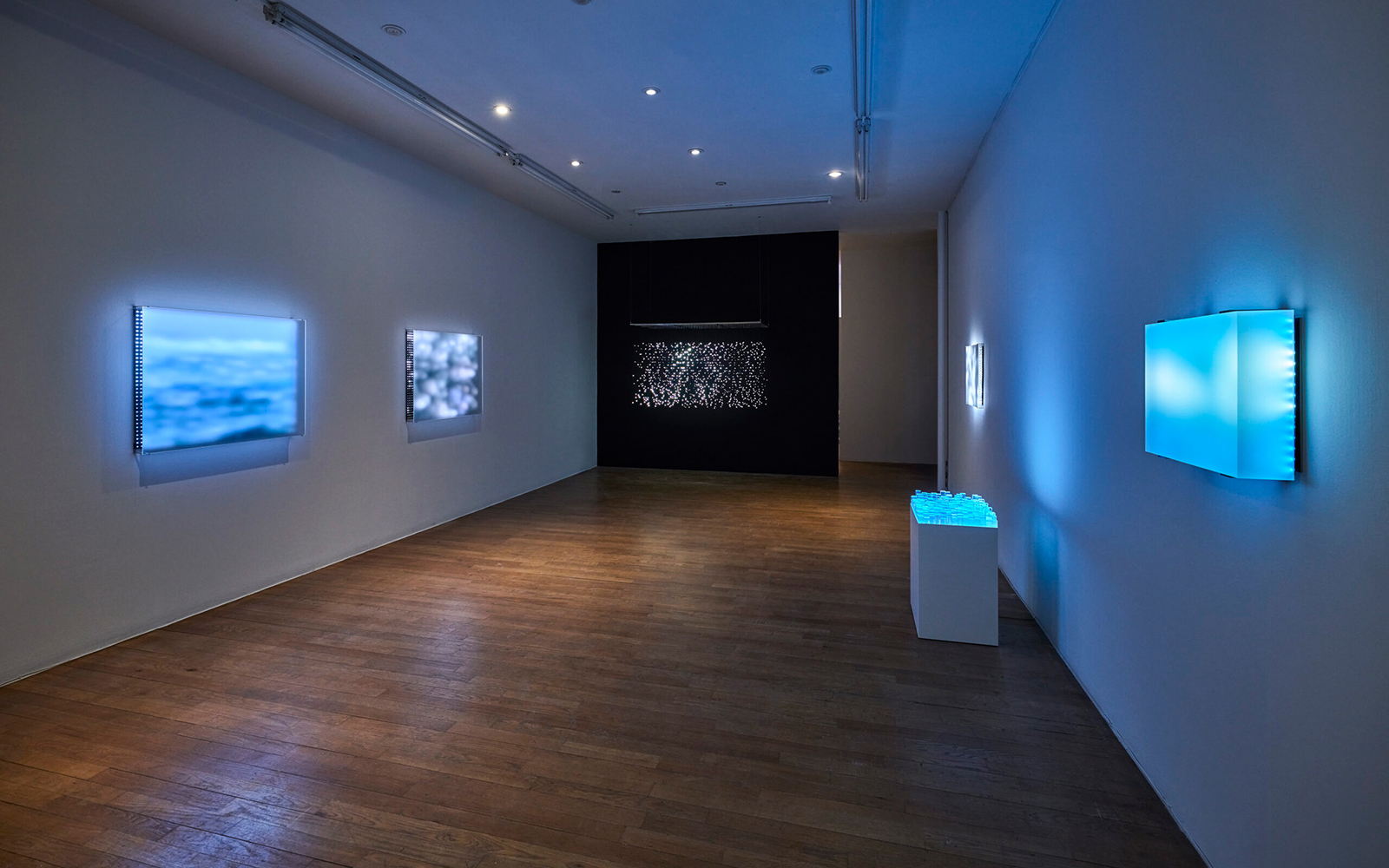
Three decades into his practice, Jim Campbell continues probing the threshold between abstraction and recognition. “Encoding Light” at bitforms NYC situates historic pieces alongside new works, positioning the American artist’s low-resolution LED installations as investigations into how perception fills in visual gaps. Motion Color Study #6 (2026), for example, translates footage of Monet’s Giverny garden into blurred colour fields—a continuation of the Impressionist’s inquiry, not a reinterpretation.
Welsh artist Cerith Wyn Evans’ “Forms in Space… by Light (in Time)” at MAAT, Lisbon, centres his monumental titular sculpture (2017). Nearly 2 km of suspended neon tubes form a 3D drawing inspired by Marcel Duchamp’s The Large Glass (1915-23) and Noh theatre movement diagrams—“a zone for meditation and a place for reverie,” says the artist. Also featured: works from the StarStarStar/Steer (Transphoton) series (2019), LED columns that pulse in sync with human breathing.

The 6th edition of RADAR, Romania’s largest new media art festival, returns to Bucharest with a showcase of cutting-edge audiovisual experimentation. Eleven installations by local and international artists and collectives, including fuse*, Marmin Guillaume, Jin Lee, panGenerator, and TUNDRA, explore how light, lasers, and projections transform space and create alternate realities. A highlight: mot’s The Pledge (2025), an interactive provocation that challenges visitors to surrender to AI.

The Diogenes Bunker in Arnhem (NL), one of the country’s largest wartime bunkers, comes alive with eco-critical art before permanently closing to the public. In “Emerging Exits,” curator Marijn Bril brings together works by Maksud Ali Mondal, Kévin Bray, Tega Brain, Silvia Gatti, Julian Oliver, Vica Pacheco, and others to create a contemplative space, cut off from sunlight and mobile reception, “where time slows down and other perspectives come into view.”

“I could have used this attention 40 years ago. But art is like it is, and you don’t get to call it always as you might like.”
James Turrell’s “The Return” fills all three floors of Pace Seoul with works spanning his curved Glassworks (2004-) installations to prints and photos from his monumental Roden Crater (1976-). Notably, the American Light and Space pioneer’s first Seoul solo since 2008 features a new site-specific Wedgework (1969-) that renders illusionary perspectival views in darkened space. As critic Han-sol Park notes, entering the installation is “like stepping into a dream that forgot it had walls.”

“Thousand Light Orchestra” transforms Toronto’s Trinity Square Video into a quasi-arcade, blurring the line between gallery and game space. Presented for Toronto Games Week, the installation by Callum Hay, Jessica Mak, and Sara Vinten features an LED cube that responds to controller input with kaleidoscopic symphonies. Projected imagery and atmospheric lighting envelop the installation, creating a playground for sonic and visual experimentation.

“It’s really exciting to have one foot on a banana peel and the other hanging over an abyss.”
“Despite their popularity and critical acclaim, teamLab—as a faceless corporate entity—remains disconnected from both art history and the tech industry, appearing profoundly isolated.”
“Myths of the New Future” brings together Taysir Batniji, Dora Budor, Jesse Darling, Agnieszka Kurant, and P. Staff at The Common Guild in Glasgow. Inspired by J.G. Ballard’s fiction, the show addresses contemporary psychosocial tensions through experimental drawing, photography, sculpture, and video. Staff’s In Ekstase (2023, image), for example, deploys five holographic fans as a medium for whirring illuminated poetry, spinning morose prose like “I AM LIVING / YOU ARE DEAD” at viewers.

“Yayoi Kusama inaugurated a new era of art specifically catering to smartphone engagement. The conceptual artist James Turrell soon had a crossover moment when Drake visited his exhibition and later used it as the inspiration for the ‘Hotline Bling’ music video.”
Christopher Bauder and Kangding Ray’s audiovisual collaboration SKALAR (2018) returns to Berlin after a seven-year global tour to inaugurate TRANSFORMATOR, a new 1,000 square-meter exhibition hall on Bauder’s DARK MATTER grounds. The 45-meter-long suspended kinetic architecture remains an engineering marvel: by coordinating 68 motorized mirrors, 90 spotlights, and a multi-channel sound system, the German light artist and French electronic musician generate an immersive, synaesthetic experience.

Inspired by Rosa Menkman’s research on image resolution, “Still Processing” Opens at Nxt Museum Amsterdam. Curated by Bogomir Doringer, artists including Boris Acket, Geoffrey Lillemon, Gabey Tjon a Tham, and Children of the Light present installations alongside Menkman. Lumus Instruments’ Polynode XI (2025, image), for example, is the studio’s latest iteration in a series of real-time audiovisualizations demonstrating how the perception of space and time extends ”beyond conscious awareness.”

Calling attention to the fading “collective memory” of World War II, panGenerator’s media sculpture Erosion (2024) confronts visitors to Berlin’s Brandenburg Gate with telling survey data. The piece, a fractured object covered in custom alphanumeric display units, draws on research conducted on behalf of the Pilecki Institute (that also commissioned the installation), highlighting “the mutability of historical knowledge and the seemingly inevitable process of forgetting.”

Showcasing UK artist Anthony McCall’s multi-decade exploration of sculptural projection, “Solid Light” opens at the Tate in London. Covering the gamut of his Solid Light Works, featured installations span Line Describing a Cone (1973), in which a 16 mm film project traces a conical volume, through Split-Second Mirror (2018, image), in which a mirror interrupts a plane of light. McCall’s recent works push at “reinterpreting sculptural space using cinematic devices,” write curators Gregor Muir and Andrew de Brún.

German experimental filmmaker and light artist Robert Seidel premieres several new works alongside painter Anna Niedhart in an unlikely XPINKY Berlin duo exhibition. The video piece Tremors (2024, image), for example, adds to Seidel’s AI pastiches where his signature CGI animations are fed into an image generator. Also new: Crispr #2 (2024), a print of painterly floral fragments and Suturae #2 (2024), a laser installation that renders cloudy geometries onto fabric.

“As if painting in space, on air, its rhythmic cycle suggesting the steady inhalation and exhalation of breath, making us more aware of our own breathing.”

A retrospective featuring experiential installations designed by the Icelandic–Danish artist over three decades, “Olafur Eliasson: Your curious journey” opens at the Singapore Art Museum (SAM). Some included works invite play and movement, like the colourful body-tracker Multiple Shadow House (2010), while others provoke, like The glacier melt series 1999/2019 (2019), a time-lapse photo grid that starkly illustrates how global warming has ravaged the Icelandic landscape (image).

Presenting selections from four perception-warping bodies of work by Korean artist Kimsooja, “Meta-Painting” opens at Tanya Bonakdar Gallery in New York. Featured are ongoing projects including To Breathe (2003-24), an ethereal projection that invites viewers to contemplate a colourful plane floating in space, and Deductive Object (1990-2024, image), a blacker-than-black ovoid sculpture inspired by the Brahmanda stone, which represents a “totality that alludes to birth and death.”

Daily discoveries at the nexus of art, science, technology, and culture: Get full access by becoming a HOLO Supporter!
- Perspective: research, long-form analysis, and critical commentary
- Encounters: in-depth artist profiles and studio visits of pioneers and key innovators
- Stream: a timeline and news archive with 3,100+ entries and counting
- Edition: HOLO’s annual collector’s edition that captures the calendar year in print