Exhibitions, Research, Criticism, Commentary
A chronology of 3,585 references across art, science, technology, and culture
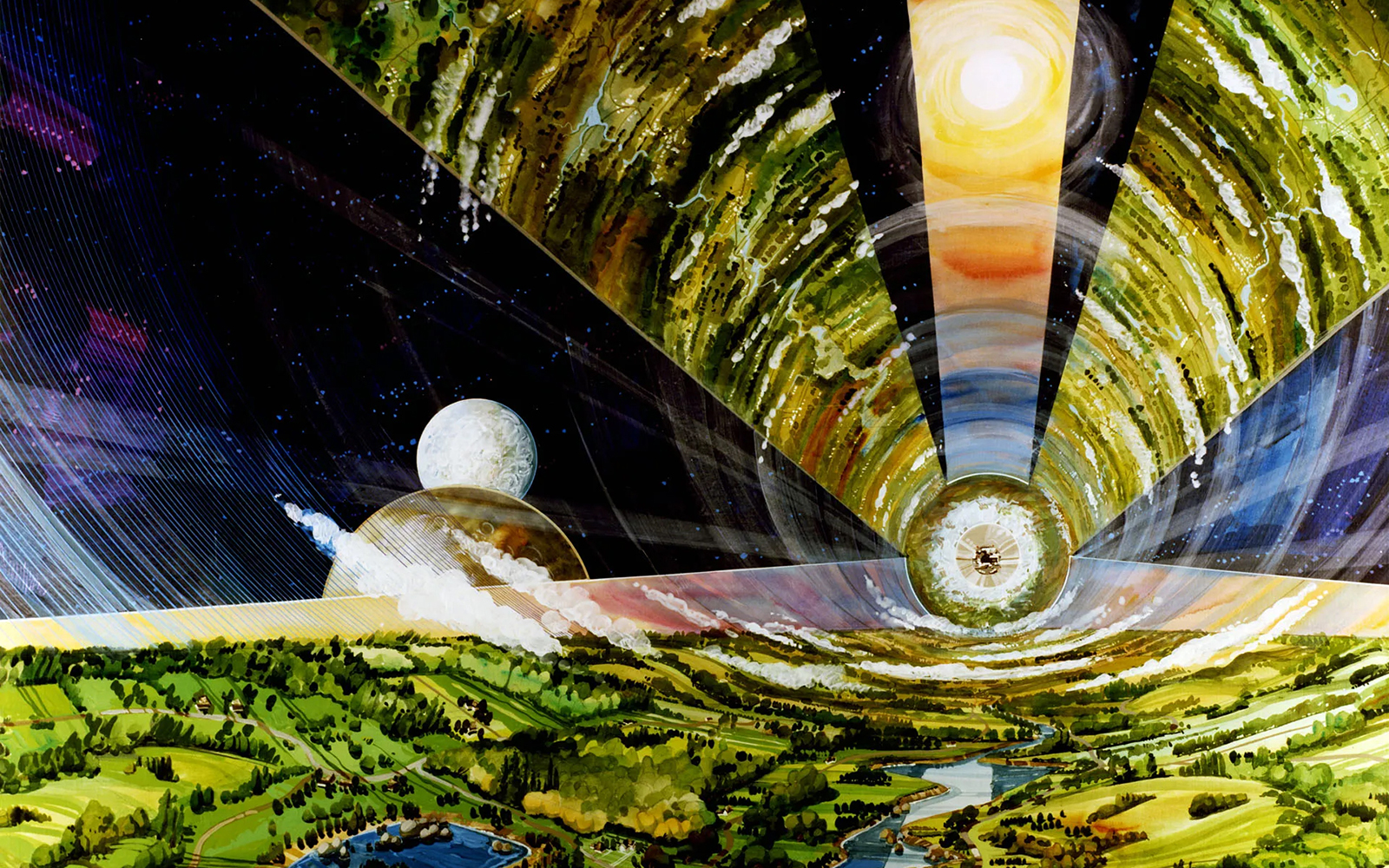
In “Where’s My Orbital Habitat?,” researcher Harry Law revisits NASA’s Space Settlements: A Design Study (1977), the Gerard K. O’Neill-led vision of orbital civilization. Rick Guidice’s paintings depict massive rotating habitats—spheres, cylinders, rings—their interiors lined with farmland curving upward. But as Law argues, the study became an expendable pawn: “NASA’s history is a negotiation between the need to dream big enough to ignite the public imagination and the need to appear credible, disciplined, and worthy of American tax dollars.”
“2025 ACC Focus: Ryoji Ikeda” celebrates the 10th anniversary of the Asian Culture Center (ACC) in Gwangju (KR) with seven works by the Japanese artist. New commissions include data.flux [n˚2] (2025), which displays DNA-derived patterns on a massive ceiling LED screen, and data.gram [n˚8] (2025), which visualizes NASA, CERN, and Human Genome Project datasets. The show reunites Ikeda with the ACC after his monumental test pattern [n˚8] (2015) inaugurated the institution.

“It’s really exciting to have one foot on a banana peel and the other hanging over an abyss.”
Brazillian developer Luizão releases schematics for a scaled-down version of the core rope memory module used by NASA in the 1960s. Deployed in interplanetary probes and the Apollo Guidance Computer, core rope memory is woven read-only memory that uses magnetic cores and wires to store data. Luizão’s implementation has 12 addresses x 8 bit values (96 bit memory)—a rotary dial cycles between data stored in each core, which is indicated by varying light combinations at the top of his assembly.

“The color pallet and compositions make an implicit argument we understand subconsciously: that looking at the depths of the cosmos is akin to looking into the 19th Century American frontier. Aesthetically, they tap into some intense American self-mythologizing.”
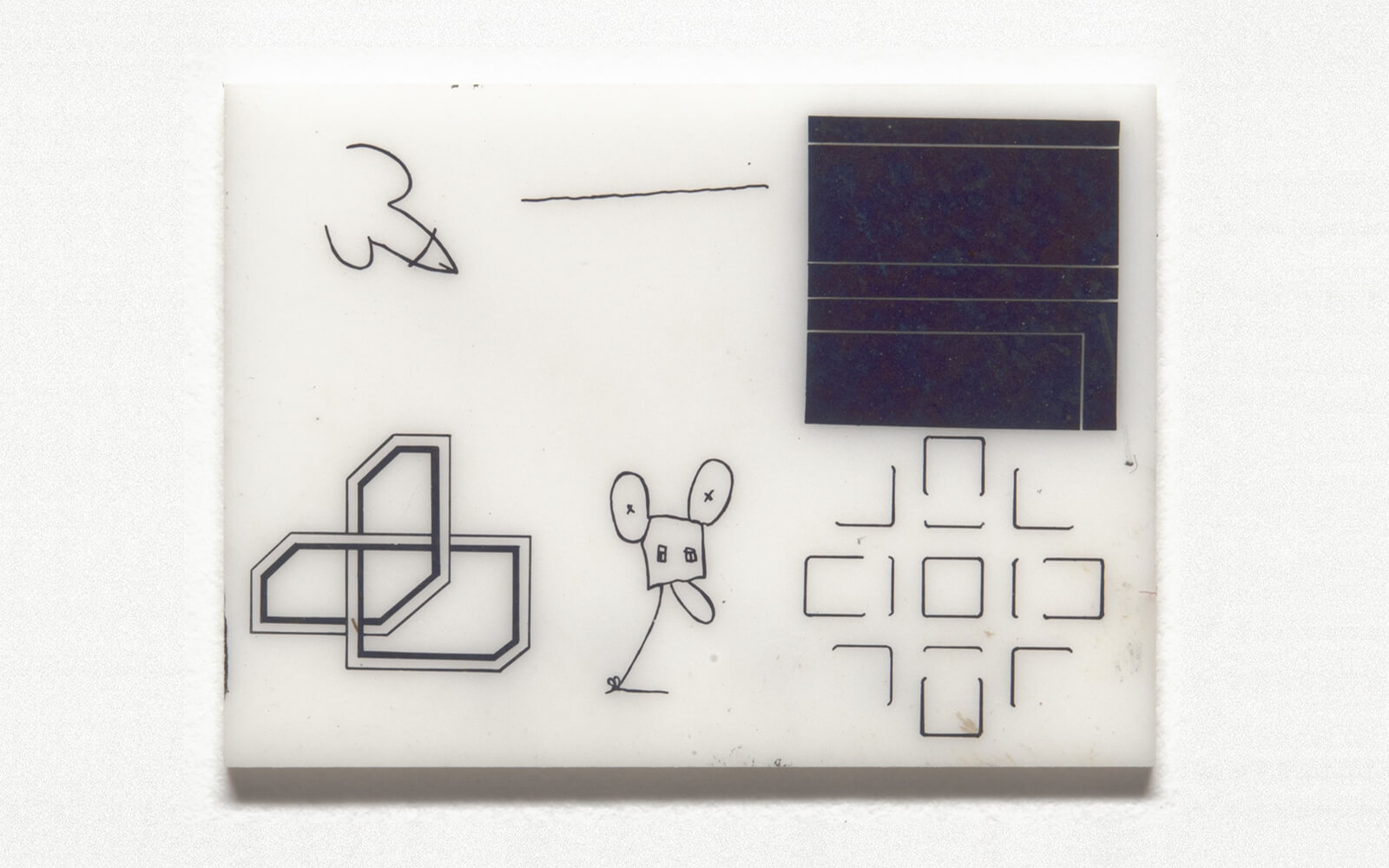
In the wake of Jeff Bezos riding a ‘giant phallus’ to space, art historian Michael Lobel reminds his Twitter followers of The Moon Museum (1969), “a tiny ceramic wafer with images by six artists covertly attached to the Apollo 12 spacecraft and reportedly left on the moon’s surface.” Realised by American sculptor Forrest Myers in collaboration with scientists from Bell Laboratories, the tile includes a sketch by Andy Warhol “that can be interpreted as a penis or a rocket ship.”
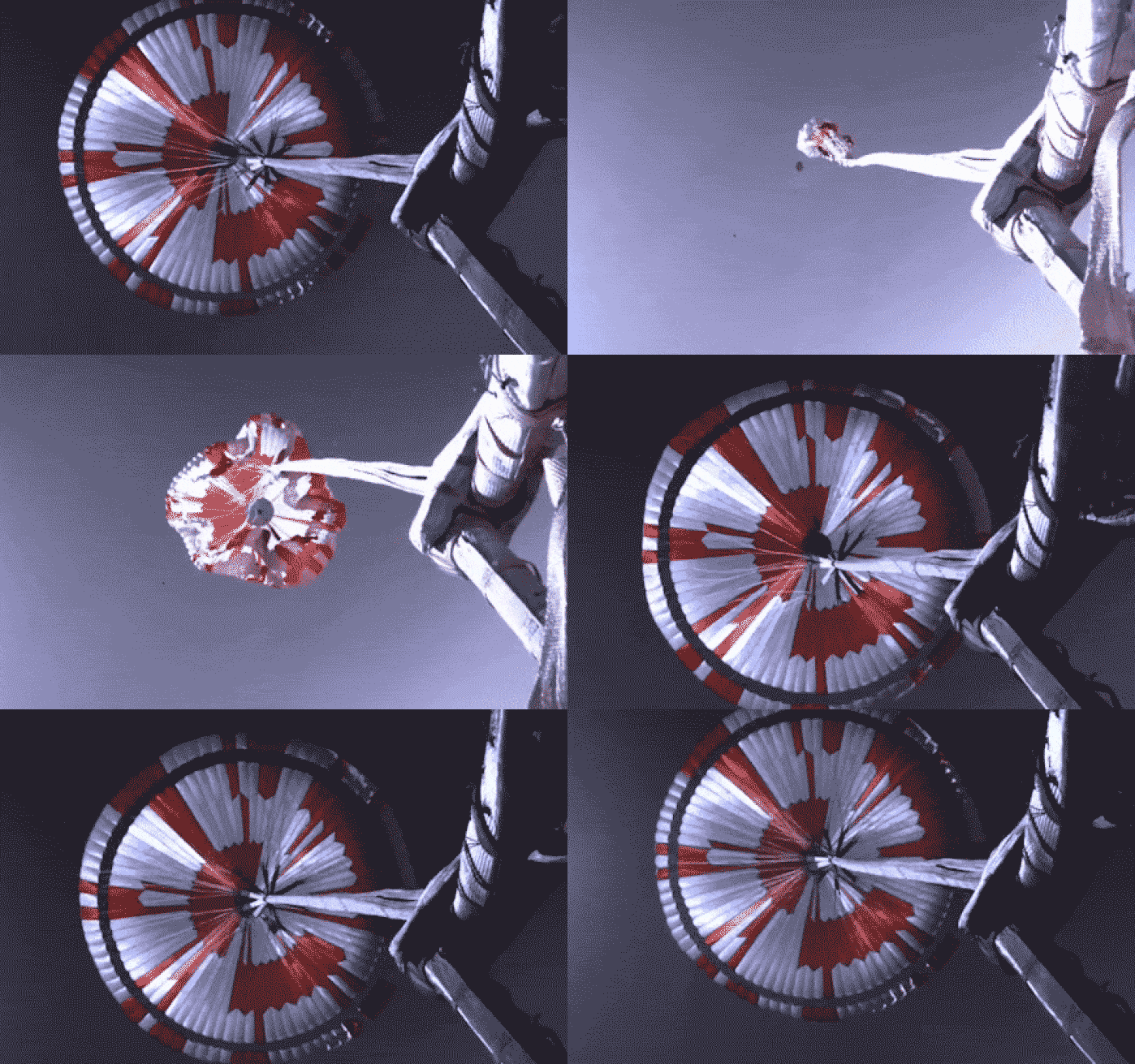
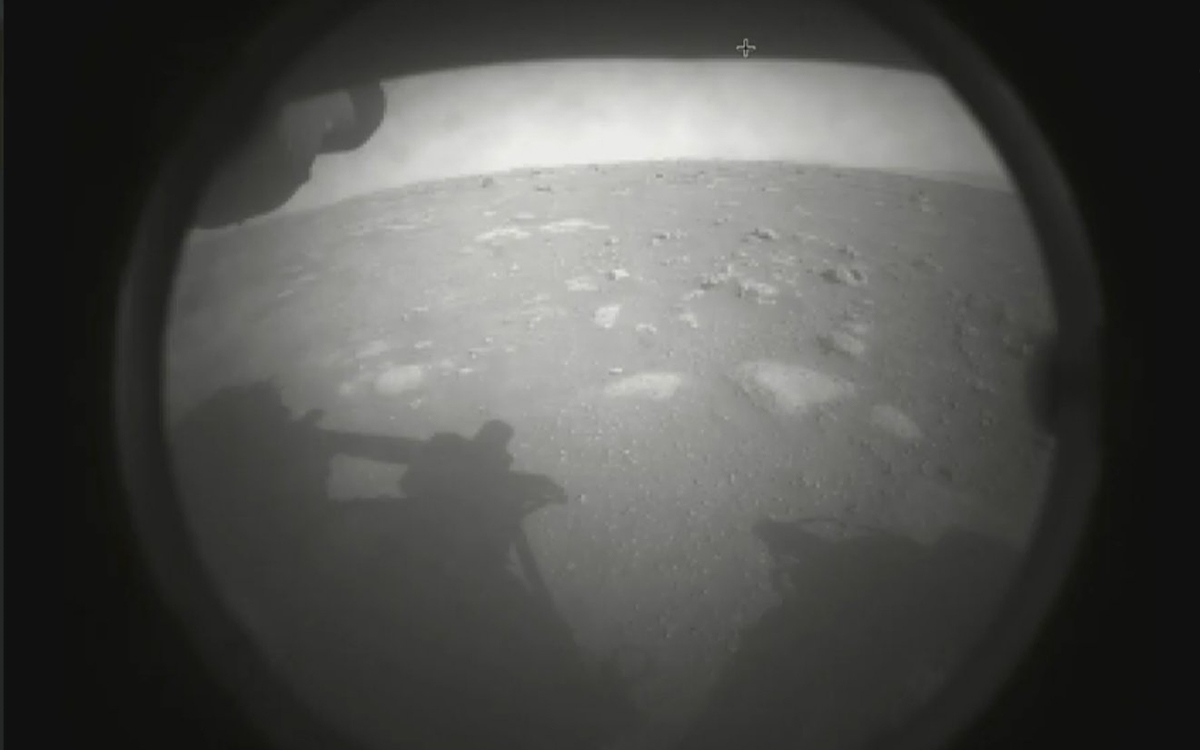
After a 203-day journey traversing 472 million kilometers, NASA confirms the touchdown of its largest, most advanced rover on Mars. With a primary objective of astrobiology research, Perseverance will search for signs of ancient microbial life and collect Mars samples (to be returned to Earth in subsequent missions). Perseverance’s first image, sent shortly after touchdown, shows the view from one of its hazard cameras. “Hello, world. My first look at my forever home,” stated the rover’s (chatty) Twitter account.
“If art is the human-friendly glove for touching transcendent reality—reality beyond our known beliefs and limits—then engineering is the bloodied hand that makes first contact.”
Daily discoveries at the nexus of art, science, technology, and culture: Get full access by becoming a HOLO Supporter!
- Perspective: research, long-form analysis, and critical commentary
- Encounters: in-depth artist profiles and studio visits of pioneers and key innovators
- Stream: a timeline and news archive with 3,100+ entries and counting
- Edition: HOLO’s annual collector’s edition that captures the calendar year in print