Exhibitions, Research, Criticism, Commentary
A chronology of 3,585 references across art, science, technology, and culture
Hito Steyerl’s “The Island” deploys science fiction as a tool for critiquing the present at Milan’s Osservatorio. Threading together flood motifs—from Nobel laureate Osamu Shimomura’s research on bioluminescent plankton to a submerged Neolithic settlement off Dalmatia—the German artist’s site-specific video installation collapses “deep time and junk time” to estrange viewers from contemporary AI authoritarianism and ecological crisis.

!Mediengruppe Bitnik’s “Computer Says No” takes over the Gothic nave of Kunsthalle Osnabrück (DE) with an exploration of the “ghostly corporeality” of artificial intelligence. In the Swiss duo’s titular installation, Qwen Stefani—an AI doppelgänger of the No Doubt vocalist—delivers affective sermons on the necessity of global unity in a moment of tech fascism. The duo also updates the Simple Sabotage Field Manual (1944), offering new tactics for everyday digital resistance.
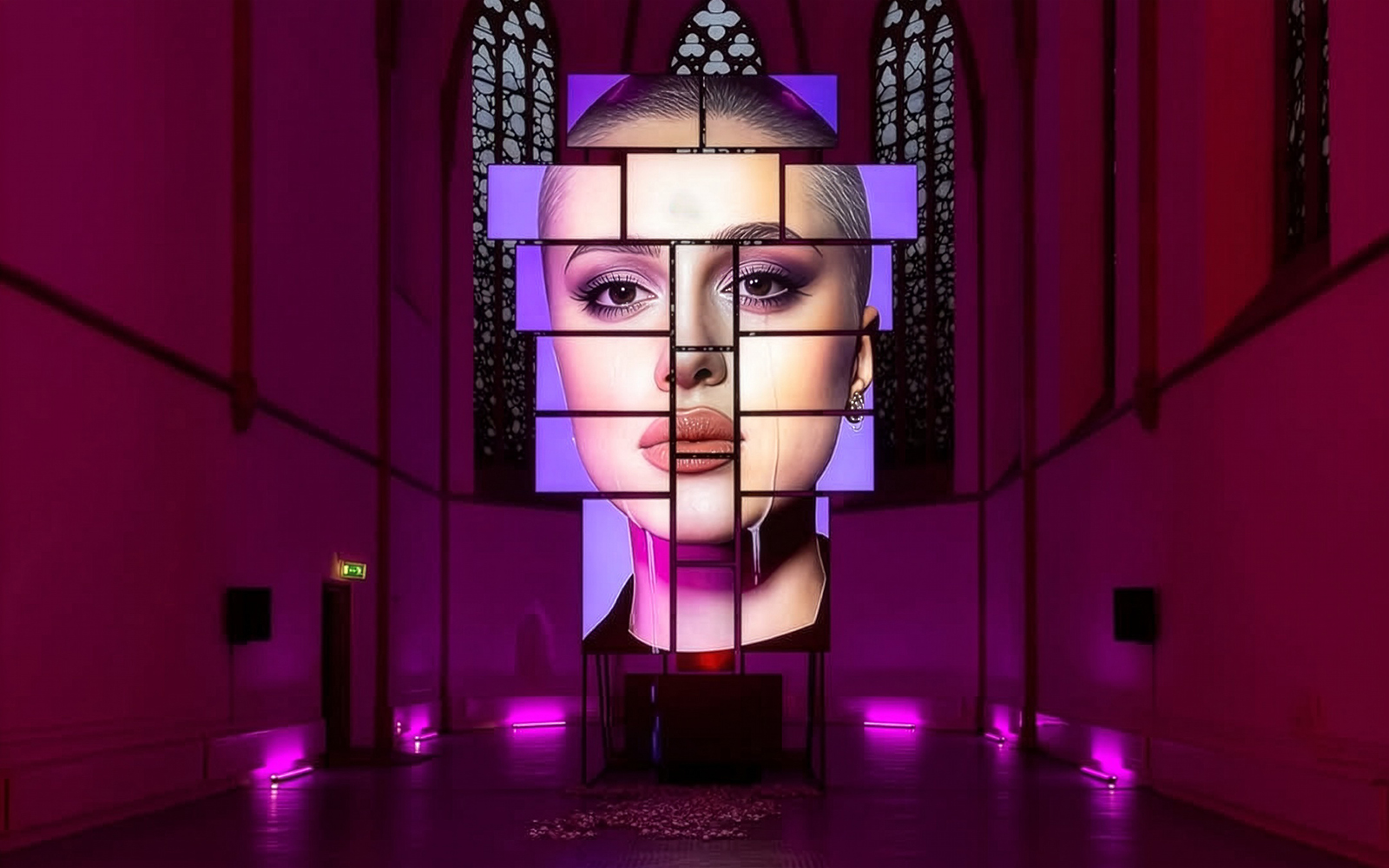
“This show is more of a love letter to IT professionals than catering to art critics.”
Brennan Wojtyla transforms Antwerp’s TICK TACK (BE) into a brutalist arcade with “LAN,” where scores of stripped-down computers become sculptural and host a Local Area Network Party. The American artist reduces hardware to essential components—every vent, cable, and chip optimized for playing classic Counter-Strike (1999)—bringing LAN-party nostalgia into the white cube. In parallel, the gallery’s architecture is transformed into a playable game map for both local and online visitors.

Janet Echelman’s “Remembering the Future” transforms climate data into sculptural form at MIT Museum, Cambridge (US). An output of her Center for Art, Science & Technology (CAST) residency, Echelman uses braided, knotted, and hand-spliced coloured twines to visualize Earth’s timeline from the last ice age through possible futures. Architect Caitlin Mueller’s accompanying digital kiosk reveal the engineering forces that achieve equilibrium in the tensile structure.

“Another day. Another night.,” Barbara Kruger’s first comprehensive Spanish survey fills Guggenheim Bilbao with text-based provocations spanning five decades. The American artist’s signature declarations challenge structures of power, identity, and control across walls, floors, and screens. Untitled (Forever) (2017/2025), a site-specific installation, surrounds visitors in Spanish and Basque text, weaving George Orwell’s dystopian warnings with Virginia Woolf’s insights on gendered power dynamics.

Spanish artist Karlos Gil explores economic stagnation and technological obsolescence in “Need for Speed,” an environment examining the shifting urban identity of Lleida (ES). Filling La Panera’s columned warehouse space with video, graffiti, and industrial detritus, the installation transforms the former grain storage facility into an “archaeology of what was and what is to come”—balancing fading agricultural heritage with glimpses of regeneration and futurity.

James Turrell’s “The Return” fills all three floors of Pace Seoul with works spanning his curved Glassworks (2004-) installations to prints and photos from his monumental Roden Crater (1976-). Notably, the American Light and Space pioneer’s first Seoul solo since 2008 features a new site-specific Wedgework (1969-) that renders illusionary perspectival views in darkened space. As critic Han-sol Park notes, entering the installation is “like stepping into a dream that forgot it had walls.”

“MOMENTUM 13: Between/Worlds—Resonant Ecologies” explores sound as a portal between human and non-human worlds in Moss (NO). Featured artists include Ralf Baecker, Natasha Barrett, Carsten Nicolai, and Jana Winderen and 36 others who curator Morten Søndergaard tasks with “revealing the vibrations that shape our shared spaces.” HC Gilje contributes The Alby Critters (2025), a follow-up to Wind-up Birds (2008) that puts robotic woodpeckers and sound-making objects in conversation with the Albyskogen forest.

Aramis Navarro blurs the line between software and the occult in “algorithmic-mega-death-superspell.exe” at Kunst Halle Sankt Gallen (CH). Driven by his central investigation of language and belief systems, the Swiss conceptual artist examines how we consult Silicon Valley apps as “contemporary oracles and magical formulae.” Featured works include Defixio (2025), aluminum curse tablets inscribed with fictitious code fragments, and Ratking’s hyper-sanctum (2025), an altar-like site-specific installation.

Agnes Denes‘ The Living Pyramid (2015, image) takes root at MUDAM Luxembourg, marking the latest iteration of her ecological installation first staged at Socrates Sculpture Park (2015) and Documenta (2017). The Hungarian-born land artist has seeded the 9-metre structure with 2,000 local flowering plants. Over 6 months, the structure will blossom, and visitors will share their opinions about the meaning of life; their responses will remain sealed in a time capsule until its unearthing in 1,000 years.

In “Welcome,” Gregor Schneider presents living space formerly occupied by a Syrian family at Haus Esters (DE). The family lived on the ground floor of the Mies van der Rohe-designed home during a closure period. Now vacant—the furniture and the sound of children’s voices are gone—only traces remain. Expressing solidarity with migrant families, Schneider “confronts the museum with a reality that unfolds outside its usual boundaries,” writes curator Sylvia Martin.

Fujiko Nakaya’s Cult of Mist (2025) drifts across Berlin’s Neue Nationalgalerie Sculpture Garden, enveloping Alicja Kwade and Henri Laurens’ sculptures amid Mies van der Rohe’s austere architecture. The Japanese artist, who has worked with fog since she infamously enshrouded the Pepsi Pavilion at Expo ’70 for E.A.T., creates a “monumental and ephemeral” presence and “fleeting, borderless transformations,” according to curators Klaus Biesenbach and Lisa Botti.

Daily discoveries at the nexus of art, science, technology, and culture: Get full access by becoming a HOLO Supporter!
- Perspective: research, long-form analysis, and critical commentary
- Encounters: in-depth artist profiles and studio visits of pioneers and key innovators
- Stream: a timeline and news archive with 3,100+ entries and counting
- Edition: HOLO’s annual collector’s edition that captures the calendar year in print