Exhibitions, Research, Criticism, Commentary
A chronology of 3,585 references across art, science, technology, and culture
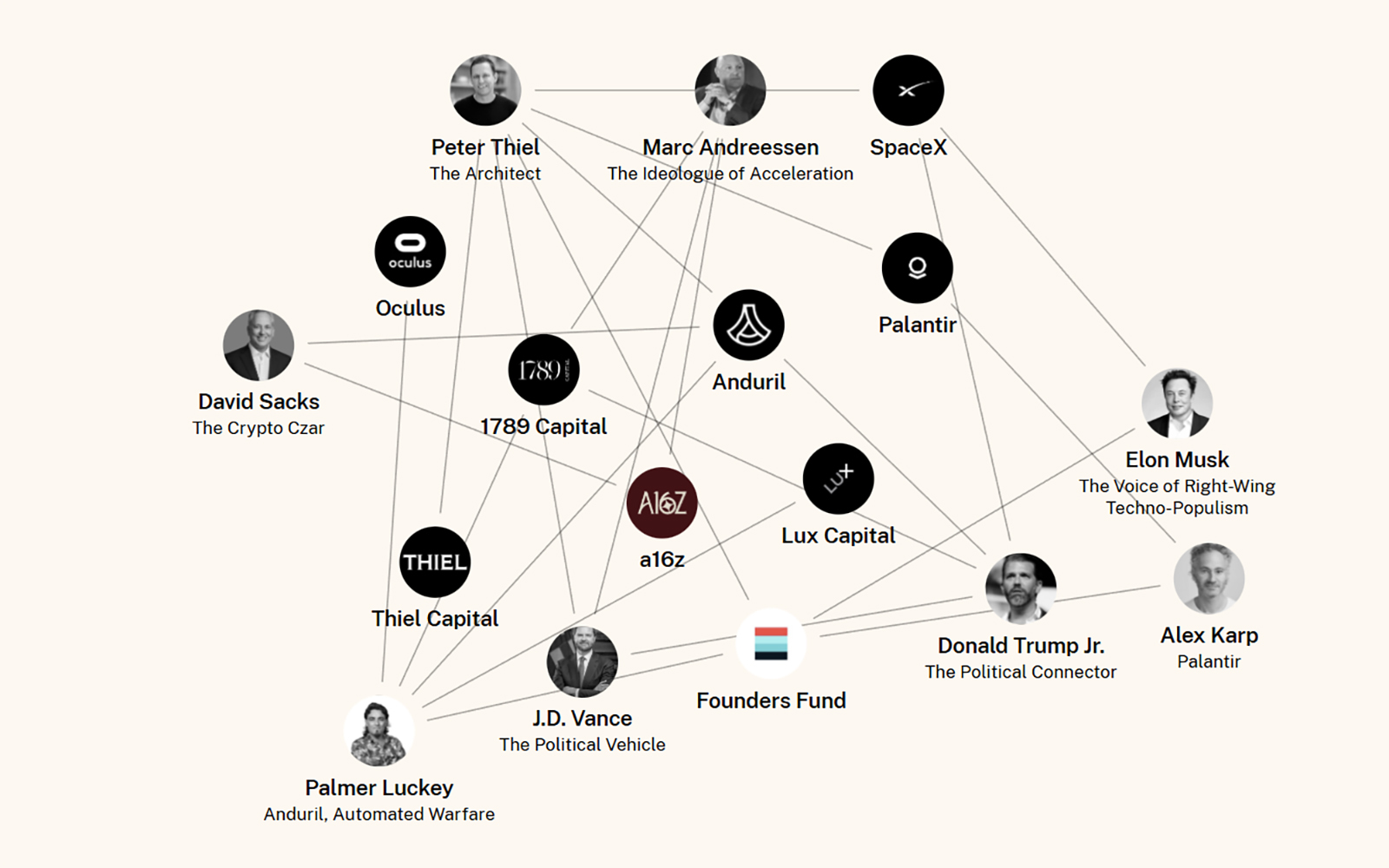
Francesca Bria and XOF Research launch The Authoritarian Stack, an interactive data visualization tracking Silicon Valley’s ascendant “patriotic tech” coalition. Drawing on an open-source dataset of 250+ actors (Alexander Karp, Palmer Luckey, Peter Thiel, etc.) and $45 billion in financial flows, the research traces how cloud platforms, AI, and defense tech, are converging into privatized infrastructure around core state functions—a system where “corporate boards, not public law, set the rules.”
Simon Denny revives Italian Futurism’s aeropainting to explore contemporary defence industry aesthetics for “The Future” at Michael Lett, Auckland (NZ). Training AI image models on Futurist paintings, Denny presents grainy abstractions of flight, iconography, and machines peppered with snippets of Anduril, Palantir, and SpaceX marketing copy. Linking technofascist moments across a century, he explores how the “futurist dream of machinic speed, aerial traversal, and war are being revived.”

“When I was a kid, it was low-Earth orbit. Now, the frontier is out near the asteroid belt, and the moon and Mars are becoming part of where humanity just hangs out, maybe not yet as people, but with robots.”
“The piece doesn’t work anymore. There are now simply too many satellites in orbit for it to function,” Quadrature’s Sebastian Neitsch reveals about the studio’s drawing machine Satelliten (2015) during a Manifest:IO lecture. When conceived, the piece would trace passing satellites in realtime on vintage maps. Since then, the number of commercial satellites has grown tenfold, Neitsch laments, overwhelming the machine and altering our night sky forever.

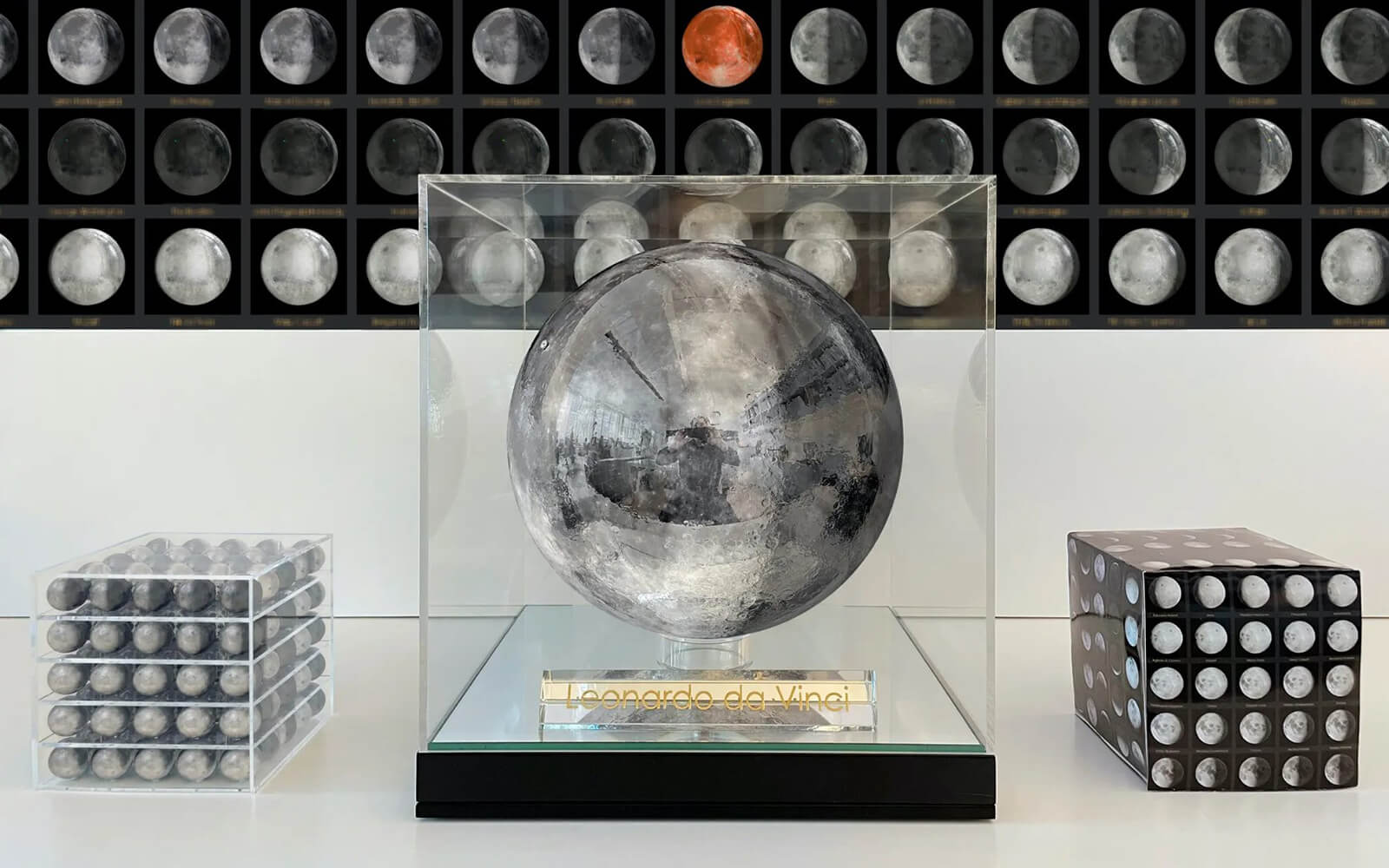
“I hate this project. The idea that Jeff Koons may be the first point of contact when we encounter extraterrestrials—when they discover his crate left on the Moon—what a statement by humanity.”
“It underscores the idea of the private space sector as a plaything for the ultra-rich.”
“By the time we’d get consensus on policy, this is all going to be over. I just think that it’s a numbers game that astronomy probably cannot win.”
“If art is the human-friendly glove for touching transcendent reality—reality beyond our known beliefs and limits—then engineering is the bloodied hand that makes first contact.”
Daily discoveries at the nexus of art, science, technology, and culture: Get full access by becoming a HOLO Supporter!
- Perspective: research, long-form analysis, and critical commentary
- Encounters: in-depth artist profiles and studio visits of pioneers and key innovators
- Stream: a timeline and news archive with 3,100+ entries and counting
- Edition: HOLO’s annual collector’s edition that captures the calendar year in print