Exhibitions, Research, Criticism, Commentary
A chronology of 3,585 references across art, science, technology, and culture
Mika Ben Amar’s Ad Space drops on Verse, presenting 111 compositions generated by a custom Chrome extension that strips websites down to nothing but ads. The Berlin-based artist’s resulting spartan canvases foreground the surveillance apparatus—targeting algorithms, behavioural profiles, the data-brokerage economy—that underwrite ‘free’ content. “I trained Google to only show me weird ads for this,” Ben Amar notes on social media.
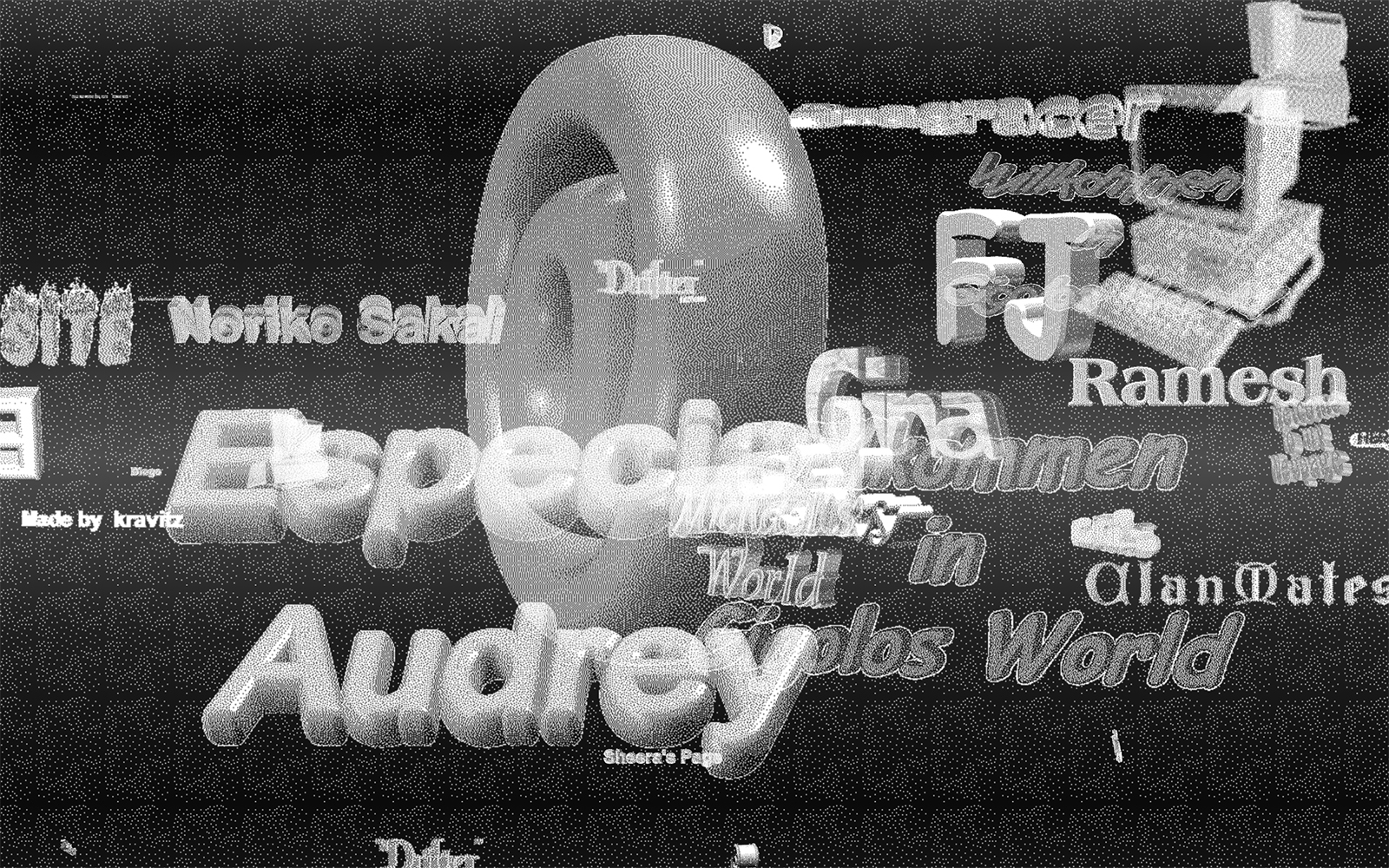
To commemorate the preservation of its trillionth webpage, the Internet Archive partnered with San Francisco arts and technology non-profit Gray Area to commission a series of original net.art works that explore what it means to create and access culture online. Ten digital artists, including Chia Amisola, Spencer Chang, Sarah Friend, and Rodell Warner, tapped deep into the Archive’s vast collections to create bespoke web experiences that “reflect on themes of memory and the human stories embedded within preserved data.”
“Because this software environment no longer exists, a perfect 1-to-1 recreation in modern code is impossible. The original work remains a unique digital artifact, tied forever to the specific technological moment of its creation.”
Austrian software artist LIA has restored re-move.org (1999-2003), a suite of ten early interactive works that launched her solo career. Originally made in Macromedia Director to be enjoyed online and on CD-ROM, the minimalist and “deeply personal” pieces have been faithfully rebuilt in p5.js for modern browsers—with one exception: re-move 09 (c. 2002) relied on a Director-specific rendering glitch that, by definition, couldn’t be reproduced.

In “Stuck? Click Here,” an Aksioma online exhibition via KUNSTSURFER, Dutch artist Lotte Louise de Jong replaces the web ads in your browser with slowed down “stuck” clips, a niche fetish genre where female bodies are wedged into sofas, office chairs or washing machines. A metaphor for our entrapment in digital platforms, de Jong’s intervention “reminds us that ‘stuck’ is no longer just a fetish but a default mode of existence online,” writes curator Hsiang-Yun Huang.

Net art veterans Cory Arcangel, JODI, Dirk Paesmans, and UBERMORGEN playfully probe the gamified mechanics of the attention economy in “Entertainment at all costs” at Wouters Gallery Brussels. UBERMORGEN contributes slogans decrying platform dynamics—“Drama Marketing,” “Trauma Dumping”—while Paesmans’ Pokemon Go Museum (2025) uses AR to riff on the commodification of cultural spaces. The show dissects how leisure has been weaponized into perpetual engagement—the churn of an endless content economy.

Seven artists examine the Seven Deadly Sins through an irreverent internet culture lens for Feral File’s “Net Evil.” Curated by Mackenzie Davenport with programming partner Rhizome, the NFT drop features Ann Hirsch, Dadabots, Damjanski, Lorna Mills, Maya Man, Shl0ms, and Steve Pikelny exploring digital depravity. Never one for subtlety, Mills’ Diatriber (2025) invokes a “giant temper tantrum” of ‘wrath’ through seven body-exploding GIFs documenting gunshots, axe strikes, and other violence.

“Canyon, at least a decade in gestation, signals that born-digital art is finally (maybe) central instead of a sideshow. An institution imagined for years as video-focused begins with the inclusion of net art and video games.”
“Screen Time. Leipzig Video Art since 1990” at Leipzig’s Museum der bildenden Künste (MdbK) explores the evolution of time-based media art, with a focus on post-Wall East Germany. The exhibition showcases three generations of artists, including Paula Ábalos, Maithu Bùi, Nadja Buttendorf, Alba D’Urbano, and Charlotte Eifler, whose works reflect the shift from single-channel video to multi-channel installations, expanded cinema, CGI, AR, and internet art.

Berlin’s panke.gallery celebrates internet culture with the first edition of “мємє яєα∂ιηg ¢ℓυв.” The rules: 20 participants, one sharing circle, everyone arrives with a meme on their phone. “One by one, we show and tell—offering up these fragments of digital culture for collective reflection,” writes host and instigator Damjanski, an internet artist who ‘lives’ in the browser. “We read them aloud, together. Interpretations overlap, clash, unravel. No meme stands alone.”

“The internet reopened the idea of spirituality. Suddenly, a non-material realm opened up and people could leave their bodies behind and be a spirit on the internet. Now this realm of the spiritual involves AI, and you have virtual agents that are not real, but feel real.”
In the second, MOCA Detroit edition of “Code Switch: Distributing Blackness, Reprogramming Internet Art,” organizer Legacy Russell shifts her focus from the history of “Black data” and African American Cybercultures (see debut) to the present day, celebrating what contemporary Black makers, including American Artist, Danielle Brathwaite-Shirley, A.M. Darke, Stephanie Dinkins, and Martine Syms, contribute to new media art and digital practice.

A month-long celebration of the organization’s tireless media art preservation efforts, “Rhizome World” showcases landmark software works by Cory Arcangel, Beatriz da Costa, Auriea Harvey & Michaël Samyn, MSCHF, Rafaël Rozendaal, Ix Shells, and others at New York’s Water Street Projects. A highlight: the new restoration of Image Atlas (2012), Taryn Simon and Aaron Swartz’ index of regional differences in top image search results developed during the 7×7 conference.

In the Kunstsurfer exhibition “Greetings from Germany,” Berlin-based artist Aram Bartholl highlights the recent increase in police violence in Germany right within your browser. Using the Kunstsurfer plugin, Bartholl replaces banner ads with cropped video clips of documented instances of excessive force. The exhibition critiques conformist media, curator Heiko Schmid explains, and serves as a painful reminder of the limits of journalistic objectivity while browsing the news.

Korean artist Yehwan Song’s first institutional solo exhibition, “Are We Still (Surfing)?,” opens at Brooklyn’s Pioneer Works. The show’s titular single work is a projection and kinetic sculpture installation that riffs on the elemental forces of water—flows, currents, whirlpools—implicit in ‘web surfing.’ Demonstrating a fixed rather than open system, Song indicts the contemporary internet as a “self-reinforcing system fueled by corporate interest while imposing surveillance and control upon individuals.”

“My practice in art school was always toward reproducible things, making things that can be copied and that can be spread. When the Internet happened, it was like, ‘Oh, this is a Xerox machine times a million.’”
Chia Amisola’s desktop and browser performance I Miss Every Sound I’ve Ever Heard, Does Anyone Feel The Same? (2024) takes over the window display of Künstlerhaus Bethanian, tantalizing Berliners with a dreamy net art narrative on sound, memory, and the body. Part of the ongoing Robert-Seidel-curated screening series “Phantom Horizons,” the Filipino internet artist’s hypertext choreography delves into the hidden layers of the Web, revealing its preset configurations and intimate connections within its digital infrastructure.

An extension of its “find.select.transform – Resilient Networks in a Wounded World” program, Berlin’s panke.gallery opens “Alt Nets,” a group exhibition offering powerful counter-narratives to extractive, hyper-capitalist technologies. Panke curators Noemi Garay and Sakrowski bring together seven works by Tega Brain with Benedetta Piantella & Alex Nathanson, James Bridle, eeefff, Ursula Endlicher, Matthias Fritsch, Everest Pipkin, and Alice Yuan Zhang that promote community, social justice, and environmental stewardship.

Jan Robert Leegte’s solo exhibition “Selection” opens at Office Impart, Berlin, presenting a series of digital artifacts such as scrollbars, JPG compression, and—all new—selection marquees as material objects, sculptures, and prints. “This ‘drag and drop’ creates a transformation from one semantic reality to another,” critic Sanneke Huisman writes about the Dutch artist’s signature practice of decontexualization. “By isolating digital elements, Leegte quietly monumentalizes them.”

Daily discoveries at the nexus of art, science, technology, and culture: Get full access by becoming a HOLO Supporter!
- Perspective: research, long-form analysis, and critical commentary
- Encounters: in-depth artist profiles and studio visits of pioneers and key innovators
- Stream: a timeline and news archive with 3,100+ entries and counting
- Edition: HOLO’s annual collector’s edition that captures the calendar year in print